

What Exactly is Workplace Wellbeing?
If you happen to have asked yourself this question then, much like the many other managers and human resource professionals who’ve done likewise, you’ve probably come to the very same conclusion: that wellbeing not a simple or singular entity to measure but rather a collection of different components that, together, form a whole.
Workplace wellbeing goes well beyond the obvious physical dimension to encompass emotional, psychological, social – or even spiritual – dimensions.
It can therefore entail a range of things: satisfactory work conditions, sound interpersonal relationships, work-life balance, opportunities for growth, the chance to contribute in a significant way…
However, while workplace wellbeing is more often broached from the standpoint of its tangible external features, we mustn’t forget that wellbeing is very much an internal concept – it’s all about how people “feel” about their work, on the inside.
Josée Blondin, Organisational Psychologist tells us that “Workplace wellbeing is strongly linked to the need to self-actualize: the need to feel fulfilled, to accomplish things and to live up to our personal and professional potential. Those needs emerge and develop differently in different people”.
How Can a Company Really Offer People “Wellbeing”?
Well then, rather than just hang some nice plants around the office, provide a top-notch meal service, or allow unlimited personal leave, the key is to focus on internal personal factors that will help a person feel innately aligned with the organization and with the job itself.
According to our research on personality and on behavior, the crucial and fundamental factor in achieving wellbeing at work happens to lie in the perception or belief that:
My job is a good fit with who I really am as a person
At Ngenio, we call this behavior-based wellbeing.
So collective workplace wellbeing is about first getting all the right people – individually – in the right job roles. For someone to feel good about their work, their self-perception needs to match closely enough with the job’s perceived behavioral requirements.
When someone doesn’t feel they can be the person that’s required or expected, frustrations inevitably develop, along with motivation issues, negative feelings and attitude problems. And this is why an appropriate match between the person and the role is the key.
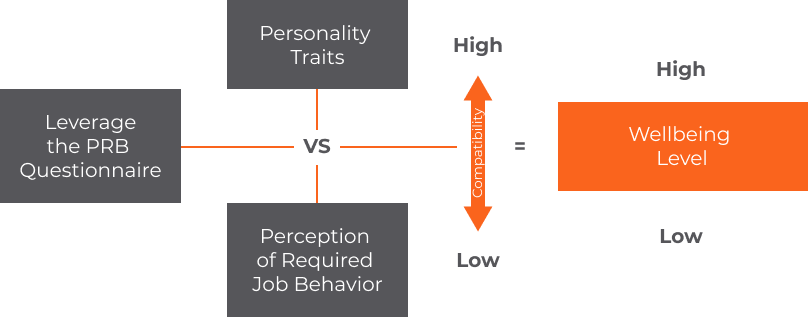
The closer the match – between innate personality traits and the job behavioral requirements – the higher the wellbeing.
Ngenio has designed a workplace Wellbeing Indicator to measure such data, as shown below.
How MPO’s Workplace Wellbeing Indicator Works
Ngenio works tirelessly at getting users more information via MPO with the least possible user-effort required
So How Do You Go About Meeting People’s Job Needs?
As shown above, to attain the highest levels of wellbeing at work, it’s crucial for the candidate’s personality traits to match closely with the position’s behavioral requirements.
Tools such as our MPO Solution help in that effort by precisely defining:
- behaviors and attitudes which would be required for optimal task execution – to successfully fulfill the role and to deliver on objectives
- the level of mastery for each of the key behavioral competencies that a job requires
- the level of mental agility and cognitive processing skills to pick up the job and readily adapt to its demands
Comparing someone’s personality traits to their perception of required job behavior produces a reliable read on wellbeing levels for a specific person in a specific position, setting and/or team.
Naturally, people are endowed with the ability to adapt to a role and to modify behaviors in order to “play the role”.
But when the gap between someone’s nature and the job requirements proves a little too extensive, a person can be stretched thin or underchallenged, which can then lead to burn out, a drop in motivation, presenteeism or people quitting.
Herein lies the value of having a fast and proven method to periodically measure staff wellbeing at your workplace.
For more on the critical matter of team wellbeing, you might want to peruse our article entitled How Do You Measure Workplace Wellbeing?